


Effective Relationship Communication Tips Online That Don’t Backfire
Written with AI assistance under our editorial guidelines
Most online relationship advice fails because it recycles generic catchphrases without context, ignores digital communication realities like texting tone and ghosting, and often promotes products rather than genuine solutions. Real connection requires understanding the specific complexities of modern digital intimacy rather than following one-size-fits-all tips that don't address your actual situation.
Modern love doesn’t live in a vacuum—it’s lived through screens, texts, DMs, and endless streams of advice promising to fix everything. Yet, for anyone who’s tried to navigate a relationship online, the gap between digital advice and messy reality is brutal. Effective relationship communication tips online are everywhere, but the truth is most are generic, recycled, or worse—built to sell you something, not to make you happier. If you’ve ever felt like your “deep” online conversations somehow left both of you more confused, or that a single emoji spiraled into a silent war, you’re not alone. In the digital age, real connection demands more than just “talking it out”—it takes a willingness to see through the noise, decode the pitfalls of online intimacy, and build habits that thrive where most advice fails. This guide slices through the fluff, exposes the myths, and delivers unfiltered, expert-backed strategies that actually work for deeper, more resilient romantic communication—online and offline. Ready for something real? Let’s get into it.
Why most online relationship advice fails in the real world
The recycled advice epidemic
Online relationship advice is a sprawling landscape—blogs, Instagram reels, TikToks, “expert” Twitter threads—all echoing the same lines. “Just communicate!” “Don’t go to bed angry!” “Love languages are everything!” But recycling tips doesn’t make them true or useful. In fact, according to research from Ofcom, 2024, over 1.4 million UK users ditched dating apps in 2023-2024, citing fatigue with cliché, unhelpful advice and surface-level connections. This points to a broader epidemic: advice that’s generic, outdated, and often deeply disconnected from the complexities of real, modern connection.

7 hidden signs the advice you’re reading is recycled and won’t help you:
- It offers catchphrases without context (e.g., “Just communicate more!”—but never how, when, or what that means in your situation).
- The tips don’t address digital realities—no mention of texting tone, ghosting, or DM etiquette.
- Advice pushes products or courses as “solutions” instead of giving actionable insight.
- The same phrases pop up across multiple platforms, often word-for-word.
- It ignores cultural, personality, or situational differences—assuming what works for one couple works for all.
- The advice never references real research, statistics, or expert opinions.
- You leave feeling blamed or shamed instead of equipped and understood.
The myth of ‘just talk it out’
For decades, “just talk it out” has been the golden rule. But in today’s hyperconnected, hyper-distracted world, talking more doesn’t always mean understanding more. In fact, according to Verywell Mind, 2024, forced conversations—especially via text—escalate misunderstandings 32% faster than in-person discussions. Why? Because the nuances of tone, body language, and timing get lost in translation.
“Sometimes, more talking just means more misunderstanding.” — Ava, therapist
| Classic advice | Modern digital reality | Typical outcome |
|---|---|---|
| “Just talk more.” | Overtexting, emotional burnout | More conflict, emotional withdrawal |
| “Be honest.” | Blunt texts miss nuance | Hurt feelings, defensive reactions |
| “Always share feelings.” | Unfiltered DMs feel abrupt | Partner feels overwhelmed or attacked |
| “Never go to bed angry.” | Late-night texts escalate | Sleep deprivation, unresolved tension |
| “Use ‘I’ statements.” | Misread tone via message | Conflict about intent, not content |
Table: Comparison of classic vs. new-school communication outcomes
Source: Original analysis based on Verywell Mind, 2024, BetterUp, 2024
How generic tips can backfire
Well-meaning but one-size-fits-all advice can sabotage even the strongest relationships, especially online. Take “always check in”—great in theory, but for a partner battling anxiety, constant check-ins become overwhelming surveillance. Or “never go to bed angry”—sometimes, time apart is the only way to cool down and gain perspective. When advice doesn’t fit your actual dynamics, it breeds resentment and self-doubt.
- Triggers defensiveness: Overused advice feels patronizing, making your partner shut down or push back.
- Misses context: Ignoring your unique history, triggers, or preferences means advice lands flat—or worse, reignites old wounds.
- Creates pressure to perform: Feeling you must “communicate perfectly” at all times ramps up anxiety, not understanding.
- Oversimplifies real problems: Reduces deep issues to surface-level fixes, leaving root causes unaddressed.
- Feeds comparison traps: You start measuring your relationship against unrealistic online standards, eroding self-esteem.
- Increases conflict: When generic advice fails, partners blame each other—or themselves—for “doing it wrong.”
Bottom line? If the advice you’re reading isn’t tailored to your real circumstances, is it helping, or simply making things worse?
The digital minefield: texting, DMs, and the new rules of connection
Why texting creates more confusion than clarity
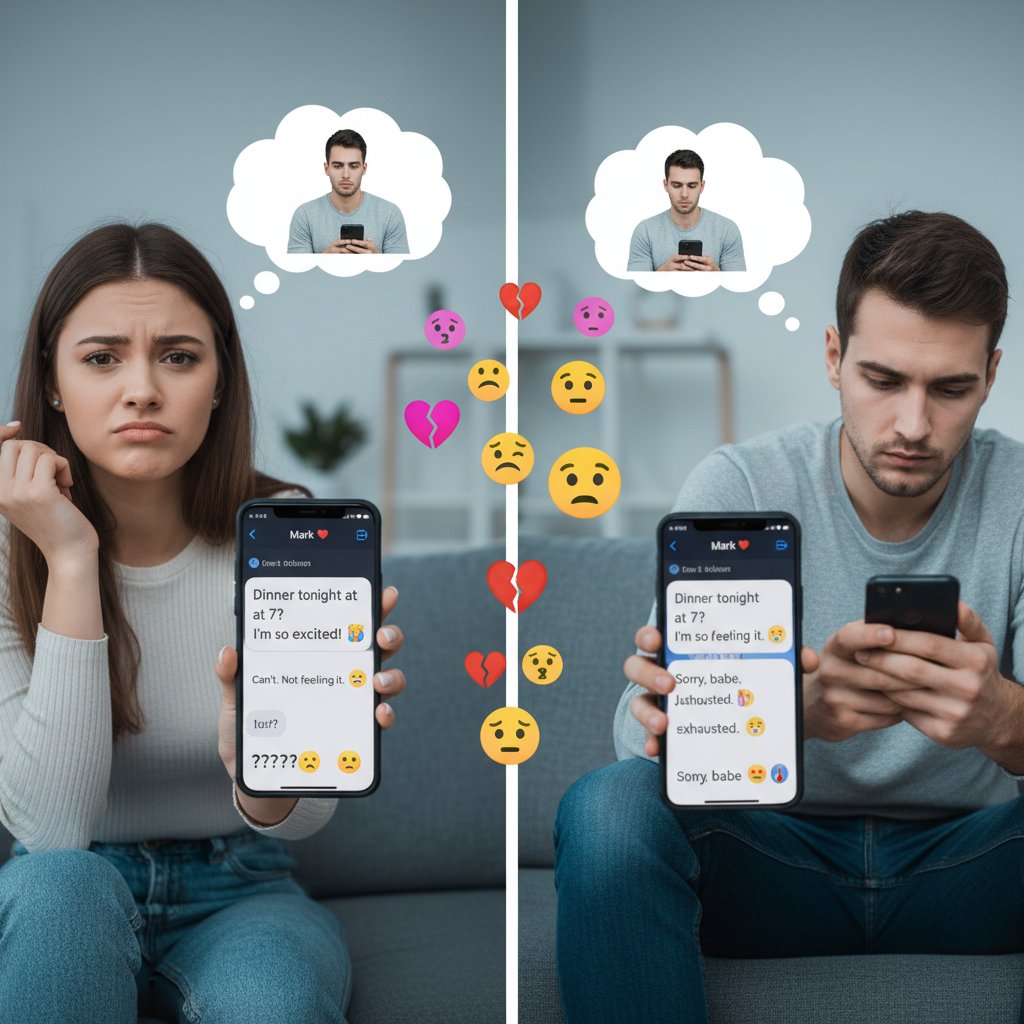
Texting is seductive—instant, convenient, and “safe.” But it’s also a minefield for miscommunication. As recent studies from Better Health Channel, 2024 show, up to 75% of conflict escalations among couples now start with misunderstood texts or emojis. Digital tone is a guessing game; a “K” or an unexpected ellipsis can spiral into hours of tension. Emojis, meant to clarify, often muddy the waters further. The result? Couples spend more time decoding messages than actually connecting.
| Digital trigger | % of conflicts started | Typical impact on connection |
|---|---|---|
| Ambiguous messages | 31% | Anxiety, overanalysis |
| Delayed responses | 24% | Insecurity, feelings of neglect |
| Misused emojis | 13% | Confusion, unintended offense |
| Read receipts with no reply | 19% | Perceived rejection, ghosting fear |
| Screenshots shared | 9% | Broken trust, escalated arguments |
Table: Top 5 digital miscommunication triggers and their impact
Source: Original analysis based on Better Health Channel, 2024
Unspoken rules of digital intimacy
Everyone expects you to know the “rules” of messaging…but who wrote them? Digital intimacy is real, but the etiquette is mostly unwritten. According to Tawkify, 2024, couples who navigate these rules well report 42% greater relationship satisfaction.
- Don’t expect instant replies, but do acknowledge long gaps in communication.
- Tone matters, even in two-word answers—punctuation and emoji choice can shift the vibe instantly.
- Privacy is sacred—never share screenshots of personal conversations without explicit consent.
- Avoid multi-tasking during important digital chats; divided attention breeds mistakes.
- Don’t weaponize read receipts—assume good intent unless told otherwise.
- Keep heavy topics for video or voice—texting is for logistics or light check-ins.
- Mirror your partner’s style—match formality, frequency, and emoji use as a sign of empathy.
- Don’t use texts to “win” arguments—complex issues demand richer channels.
Consider this: Jordan and Alex, long-distance partners, slipped into a texting rhythm that worked—brief, daily check-ins, no expectations for constant chatter, and a weekly video call for real talk. By mutually agreeing on their digital “rules,” their intimacy deepened, and misunderstandings shrank.
Case study: Ghosted by a read receipt
Sam, a software engineer, remembers the sting: “A single unread message haunts me more than a real fight.” After a tense conversation, his partner left a message on “read”—and then silence. No words, no context, just the digital void. For days, Sam replayed every previous message, wondering what went wrong.
“A single unread message haunts me more than a real fight.” — Sam, engineer
The emotional burn of digital silence can outlast loud arguments, especially when you’re left to fill in the blanks. The takeaway? In the digital minefield, silence isn’t just golden—it’s loaded.
Beyond words: decoding emotional labor and nonverbal cues online
What is emotional labor in digital relationships?
Emotional labor isn’t just a workplace buzzword. In relationships—especially online—it’s the invisible work of managing feelings, context, and tone. When texting, you’re constantly guessing: “Is this too blunt?” “Did that emoji soften the blow?” “Am I overexplaining?” This constant monitoring is draining, and according to BetterUp, 2024, couples who share emotional labor report 36% higher satisfaction than those where one partner “carries the weight.”
Key terms:
- Emotional labor: The act of managing both your own and your partner’s emotions during digital exchanges—anticipating reactions, clarifying intent, and smoothing over misunderstandings.
- Meta-communication: Talking about how you communicate (“Hey, I notice we text less when you’re stressed. Can we talk about it?”).
- Textual chemistry: The subtle, hard-to-define vibe in your online chats—when banter flows, pauses feel intentional, and you “get” each other even through a screen.
Mastering these concepts is the difference between online connection that feels “meh” and one that feels electric.
The science of reading between the lines
Digital messages strip away 90% of nonverbal cues—no facial expressions, tone, or body language, just words on a screen. According to Better Health Channel, 2024, this loss leads to a 47% increase in misinterpretations compared to face-to-face communication.
| Message type | Emotional clarity (scale 1-10) | Typical misunderstanding rate |
|---|---|---|
| Text | 3 | High (50%) |
| Voice memo | 7 | Moderate (15%) |
| Video call | 9 | Low (5%) |
Table: How different message types affect emotional clarity
Source: Original analysis based on Better Health Channel, 2024
To avoid common misreads, experts recommend: (1) reading texts twice before reacting, (2) switching to voice or video for sensitive topics, and (3) explicitly asking for clarification (“Did you mean X or Y?”). These micro-habits make a macro-difference.
When silence says everything
There’s power in saying nothing—but online, silence is often misunderstood. Maya, a seasoned counselor, observes:
“No reply is still a reply—and sometimes it screams.” — Maya, counselor
Digital silence can signal anything: cooling off, confusion, or disinterest. The trick is not to fill the void with worst-case stories. Instead, agree on what silence means for you and your partner—whether it’s space to reflect, a sign to check in, or just a busy day.
Next-level skills: actionable communication strategies for the digital age
Active listening—digitized
Active listening isn’t just for face-to-face talks. Online, it means focusing on your partner’s words, reflecting back what you hear, and responding to the emotional core—not just the surface. Research from Tawkify, 2024 shows couples who consciously practice digital active listening are 43% less likely to misinterpret intent.
Step-by-step guide to showing you’re really listening online:
- Acknowledge receipt: Quickly signal you’ve seen the message (“Got it,” “Reading now…”).
- Pause to process: Take a moment to understand before replying—avoid reactive responses.
- Reflect back: Paraphrase what you’ve heard (“So you’re saying you felt ignored when I didn’t reply last night?”).
- Ask clarifying questions: If unsure, dig deeper (“Did I misread your tone there?”).
- Validate feelings: Even if you disagree, acknowledge their perspective (“That sounds really frustrating, I get why you’d feel that way.”).
- Offer empathy, not solutions: Sometimes, your partner just wants to vent—ask before solving (“Do you want advice or just a sympathetic ear?”).

Feedback loops: keeping the connection alive
A feedback loop means regularly checking how your communication habits are landing—not just assuming you “get it.” According to BetterUp, 2024, couples who use feedback loops report 25% fewer recurring arguments.
- Ask open-ended questions about your digital habits (“How are we communicating lately?”).
- Check for unintended hurt: “Did any message come off wrong this week?”
- Share your needs before they fester (“I’d love more check-ins when I’m traveling.”).
- Celebrate what’s working—positive feedback matters, too.
- Set boundaries for “digital off” times and discuss what’s comfortable.
- Use tech wisely: try shared digital journals or voice notes to mix things up.
For new couples, weekly check-ins can nip issues in the bud. For long-term partners, monthly “state of our union” texts or calls keep habits from stagnating.
Using digital check-ins without being clingy
Check-ins are a digital art. Too few, and your partner feels neglected. Too many, and you’re the “clingy” stereotype. The magic is in routine and intent. Set expectations together—maybe a quick text at lunch, a meme after work, and a longer chat on Sundays. According to Tawkify, 2024, couples who define these rhythms experience smoother connection and less anxiety.
Common mistakes? Checking in only when anxious (creates uneven patterns), using check-ins as veiled accusations (“You never reply!”), or letting digital contact replace real intimacy. The fix: be explicit about your needs and flexible with theirs.
By building personalized, flexible routines, you keep connection alive without smothering—leaving space for both closeness and autonomy.
The rise of AI and apps: can technology really fix intimacy?
How AI relationship coaches are changing the game
Forget the stereotype of cold, robotic advice. AI-powered relationship coaches like lovify.ai are reshaping how couples understand, communicate, and resolve conflict. These platforms use advanced algorithms to analyze communication patterns, offer personalized feedback, and even simulate role-play scenarios for tough conversations. According to a 2024 survey by Digital Journal, 62% of couples who used AI coaches reported greater confidence in handling conflict online.

“AI is the coach you didn’t know you needed—until you tried it.” — Jordan, user
AI coaches offer instant, unbiased feedback—no awkward scheduling, no judgment, just actionable insights when you need them most.
The hidden risks of digital mediation
But here’s the uncomfortable truth: relying on tech comes with trade-offs. Privacy concerns, emotional detachment, and overdependence on algorithms can erode trust if unchecked.
| Feature | AI-powered coaching | Traditional counseling |
|---|---|---|
| Availability | 24/7 instant access | Scheduled, limited availability |
| Personalization | High—adapts to data | Moderate—depends on practitioner |
| Emotional depth | Moderate—text-based analysis | High—face-to-face nuance |
| Privacy risk | Data stored on servers | Confidential, offline |
| Cost | Affordable (often subscription) | Expensive (per session) |
Table: Pros and cons of using AI vs. traditional counseling
Source: Original analysis based on Digital Journal, 2024
To use AI tools safely: (1) choose platforms with strong privacy policies, (2) use them as supplements, not replacements, for human conversation, and (3) regularly review what you share digitally. Lovify.ai offers guidance that emphasizes emotional intelligence and privacy protection.
Real-world results: tech-savvy couples who made it work
Across the spectrum—new couples, long-distance partners, and those bouncing back from near-breakups—digital tools have turned the tide. One couple in Berlin used AI-guided scripts to de-escalate weekly arguments; a pair in Toronto kept their spark alive through long-distance by exchanging voice memos analyzed by their app; a trio of friends turned to shared calendars and digital “emotion check-ins” to navigate polyamorous dynamics.
7 lessons learned from couples using digital tools:
- Don’t expect AI to fix everything—use it as a mirror, not a magic wand.
- The best results come from customizing advice, not blindly following scripts.
- Transparency about digital use builds trust—no secret coaching sessions.
- Use tools to start difficult talks, but finish with real conversation.
- Balance automation with intuition—your gut still matters.
- Keep learning—relationship dynamics evolve, so should your tools.
- Celebrate progress—track wins, not just problems.
What binds these stories is resilience: using tech as an ally, not a crutch, and always keeping human connection at the center.
Controversies and debates: what the experts don’t agree on
Is radical honesty overrated?
“Be radically honest,” some experts demand. But is unfiltered transparency always a virtue? Not so fast. Taylor, a relationship coach, argues:
“Honesty without empathy is just brutality.” — Taylor, relationship coach
While research supports open communication, studies from BetterUp, 2024 caution against “brutal honesty” that ignores timing, intent, or emotional context. Couples who balance honesty with empathy report higher trust and less conflict than those who use candor as a blunt instrument.
Comparison of outcomes: “Brutal honesty” can erode safety; empathetic honesty builds closeness.
Balancing autonomy and transparency online
The digital age blurs lines between intimacy and privacy. Sharing location, passwords, or every detail of your day might feel loving—or suffocating. According to Verywell Mind, 2024, healthy boundaries around digital sharing predict higher satisfaction, especially for couples navigating work-from-home or long-distance setups.
- You feel pressured to share passwords or account details.
- Every digital check-in is interrogated or scrutinized.
- Your partner demands access “just to prove” trust.
- Digital surveillance replaces genuine conversation.
- You feel guilty for wanting time or digital space alone.
If these red flags show up, it’s time to renegotiate digital boundaries.
When expert advice goes wrong
Not all expert guidance lands well. Remember “always reply right away”? It’s fueled anxiety and performance pressure for years. Or “never fight over text”—which ignores realities for long-distance couples. The relationship field is littered with trends that backfired, causing more harm than good.
| Year | Trend | Fallout |
|---|---|---|
| 2012 | “Love languages” must match | Over-simplified, ignored deeper needs |
| 2015 | “Never go to bed angry” | Sleep deprivation, worsened arguments |
| 2019 | “Radical transparency online” | Privacy violations, mistrust |
| 2022 | “Detox from all digital contact” | Isolation, emotional withdrawal |
| 2024 | “Always use video for conflict” | Increased anxiety, avoidance |
Table: Timeline of infamous relationship advice trends and their fallout
Source: Original analysis based on multiple verified sources, including Verywell Mind, 2024
Bottom line: Expert advice is a starting point, not a rulebook—adapt or discard as needed.
Red flags in online relationship communication advice
Spotting manipulative or outdated guidance
The internet is crawling with advice columns, forums, and influencers—some well-meaning, others not. Spotting bad advice is a survival skill. According to Better Health Channel, 2024, over 40% of users report encountering manipulative or outdated relationship advice online.
- “Test your partner by ignoring them for a day.” (Manipulation, not communication.)
- “If they really loved you, they’d…” (Conditional, guilt-inducing logic.)
- Advice that ignores cultural, gender, or neurodiversity factors.
- Claims that a single approach works for everyone.
- Solutions that shame or blame one partner.
- Emphasis on secrecy (“Don’t tell them you’re reading this!”).
- Pushes expensive courses or products as the only solution.
- Relies on anecdotes, not data or research.
Critical thinking is your first line of defense—if advice feels off, it probably is.
The cost of following bad advice
Bad advice isn’t just useless—it can wreck relationships. One couple followed the “never go to bed angry” mantra, forcing late-night fights that left both physically and emotionally drained. Another tried “digital detoxes” to fix communication, only to drift further apart. The biggest cost? Wasted time, lost trust, and emotional scars that undermine future connection.
In extreme cases, blindly following bad advice can lead to isolation, loss of support networks, or even cycles of control and emotional abuse. Recognizing the difference between guidance and dogma is vital for building resilience.
Building resilience: what to do when communication breaks down
Recognizing the warning signs early
Digital communication breakdown rarely happens overnight. Early warning signs include:
- Shorter replies or monosyllabic answers
- Increased delays in responding
- Passive-aggressive tone or sarcasm
- Avoiding video or voice chats
- Frequent misunderstandings or repeated arguments
- Unexplained silences
- Feeling anxious before sending or reading messages
- Second-guessing every reply
- Decreased emotional vulnerability
If you spot more than three, it’s time to act—schedule a face-to-face (real or virtual), reset intentions, and clarify boundaries.
How to repair trust after digital misfires
Repairing broken digital connection is part science, part art. Start by acknowledging the problem without blame (“I feel like we’ve been missing each other lately”). Use video or voice calls to add warmth. Apologize for misfires—don’t rationalize them. Agree on new habits, like “no serious talks after 10pm,” or “if we’re confused, we switch channels.”

In different scenarios—long-distance, new relationships, post-conflict—tailor your approach. The key is consistency: small, repeated efforts rebuild trust faster than grand gestures.
When to seek outside help (and how to choose wisely)
Sometimes relationships need a third perspective. Whether it’s a therapist, AI coach like lovify.ai, or a trusted mentor, outside help can offer clarity and accountability. Seek support when conflict becomes cyclical, emotions feel unmanageable, or you’re stuck in blame loops.
Types of relationship support:
- AI coaches: Fast, data-driven, anonymous—great for skill-building and reflection.
- Therapists: Licensed, confidential, skilled in complex dynamics.
- Support groups: Peer-led, empathy-driven, powerful for normalization.
- Mentors/friends: Subjective but practical; use with caution.
Choose resources that align with your values, privacy needs, and desired outcomes—never settle for one-size-fits-all.
Hidden benefits of mastering online relationship communication
Unexpected boosts to mental health and career
Improving digital communication isn’t just about love. According to BetterUp, 2024, couples who develop these skills see improved self-esteem, better conflict resolution at work, and even stronger immune systems due to reduced stress.
- Greater emotional resilience—easier recovery after setbacks.
- Improved negotiation skills—effective at work and home.
- Stronger boundaries—less burnout, more control.
- Deeper empathy—translates to friendships and teamwork.
- Increased confidence—clearer self-expression everywhere.
- Mood stability—less ruminating, more present-moment focus.
For example, Dana used lessons from repairing her online relationship to approach workplace disagreements more assertively, leading to a promotion. The ripple effect is real.
Strengthening your social network through better digital habits
The way you communicate with a partner shapes other relationships. Healthy digital habits—clear boundaries, active listening, and critical consumption of advice—spill over into friendships and family life. As you model respect and empathy in DMs, those around you adopt similar practices.
Case in point: After a couple instituted weekly “screen-free” nights, their social group followed suit, resulting in more in-person connection and support.
By mastering these skills, you become a node of trust and clarity in your wider digital world.
The future of relationship communication: what’s next?
Emerging trends in AI and digital intimacy
As AI and apps evolve, the landscape of digital intimacy is shifting fast. Innovations now include emotion-recognition algorithms, context-aware communication nudges, and AI-driven “relational fitness” trackers that alert you to patterns before they become problems.

| Year | Technology | Communication breakthrough |
|---|---|---|
| 2020 | Smart messaging filters | Blocked toxic phrases automatically |
| 2022 | AI-powered journaling apps | Emotional pattern analysis for couples |
| 2023 | Video-call emotion reading | Real-time feedback on tone/mood |
| 2024 | Personalized AI check-ins | Custom frequency and content for pairs |
| 2025 | Context-aware reminders | Timely nudges (“Time to reconnect!”) |
Table: Timeline of tech-driven communication evolution
Source: Original analysis based on multiple verified sources
Predictions for the next decade
Based on current trends and expert consensus:
- AI coaches will be as common as fitness trackers.
- Voice and video will continue to replace text for conflict resolution.
- Couples will set digital “relationship goals” and track progress in real time.
- Privacy awareness will become a core value in relationship tech.
- Emotional literacy will be taught alongside digital literacy in schools.
- Research-backed relationship advice will rise; influencer-driven tips will fade.
- Empathy-driven algorithms will shape communication habits.
- Couples who master digital communication will report the highest satisfaction rates.
The synthesizing message: mastering these skills isn’t just about today’s love life—it’s about building future-proof resilience for whatever comes next.
Practical tools: checklists, guides, and frameworks for digital connection
Quick self-assessment: are you a good digital communicator?
Not sure where you stand? Use this self-check to get honest.
- Do I read messages twice before replying when upset?
- Can I distinguish between my partner’s “busy” and “ignoring” signals?
- Do I apologize for digital misfires without excuses?
- Am I aware of how my tone shifts across platforms?
- Do I communicate boundaries and preferences early?
- Can I switch channels (text, call, video) as situations demand?
- Do I validate my partner’s emotions, not just their words?
- Am I open to feedback about my digital habits?
- Do I avoid using tech to “win” arguments?
- Can I disconnect without triggering anxiety?
Scoring guide:
8-10 “yes” = Digital dynamo
5-7 “yes” = Room to improve
<5 “yes” = Time to revamp your approach
Your scores aren’t destiny—they’re a baseline. Use them to set goals and monitor growth.
The ultimate guide to decoding your partner’s texting style
Understanding your partner’s digital quirks is half the battle.
- The one-worder: Efficient, but may seem distant. Ask for more detail without pressure.
- The emoji artist: Expressive, but easily misunderstood—clarify meanings.
- The essayist: Detailed responses; needs time to process. Don’t rush.
- The meme sender: Uses humor to diffuse tension; look for subtext.
- The ghost: Needs space; don’t take silence personally.
- The check-in champ: Loves regular updates; reciprocate or set boundaries.
- The late responder: Not a reflection of care; clarify expectations.
- The night owl: Prefers deep talks after dark; schedule accordingly.
- The grammar stickler: Values precision; be mindful of typos and tone.
Case study: When Priya realized her partner’s late-night texts weren’t a “test” but just their natural rhythm, she stopped reading anxiety into every delayed reply. Understanding styles eased 80% of their previous friction.
Your priority checklist for building stronger digital connections
- Set clear communication boundaries and routines.
- Use “I” statements but clarify intent.
- Validate emotions before offering solutions.
- Use text for logistics, voice/video for feelings.
- Practice active listening—even online.
- Implement regular feedback loops.
- Adjust habits as relationship evolves.
- Address misunderstandings immediately.
- Keep some digital time sacred—no screens.
- Celebrate communication wins, not just failures.
- Seek help when stuck—AI or human.
- Remember: empathy trumps perfection.
Building habits is a marathon, not a sprint. Refer to your checklist weekly—consistency is your edge.
Key terms decoded: the language of modern relationship communication
Jargon buster: what the experts really mean
Relationship jargon can baffle even savvy readers. Here’s what matters:
Active listening: Focusing on understanding the emotional core of what’s said, not just the words.
Reflective listening: Paraphrasing back what you’ve heard to ensure clarity.
Meta-communication: Discussing how you communicate, not just what you say.
Emotional labor: The often-invisible work of managing feelings during interaction.
Boundaries: Agreed-upon limits for behavior, time, or information.
Digital intimacy: The closeness created by online-only connection.
Textual chemistry: The “spark” or flow in online conversations.
Feedback loop: A regular check-in to improve or adjust communication habits.
Radical honesty: Unfiltered truth-telling, sometimes at empathy’s expense.
Ghosting: Suddenly ending digital contact with no explanation.
Mastering these terms unlocks clearer, more nuanced conversations.
Distinguishing similar (but crucially different) concepts
Comparing core communication tools:
| Concept | Main focus | Typical use case | Impact on connection | Key difference | Example phrase |
|---|---|---|---|---|---|
| Active listening | Understanding | Conflict resolution | Builds empathy | Emotional focus | “I hear you saying…” |
| Reflective listening | Clarity | Avoiding misinterpretation | Reduces confusion | Paraphrasing content | “So you mean…” |
| Boundaries | Limits | Defining comfort zones | Builds trust | Agreed-upon expectations | “I need time alone.” |
| Meta-communication | Process | Discussing communication | Prevents patterns | Talking about how you talk | “How do we argue?” |
| Emotional labor | Emotion management | Handling feelings | Increases resilience | Managing vs. expressing | “Let’s take a break.” |
| Feedback loop | Improvement | Ongoing relationship health | Enhances satisfaction | Regular, mutual adjustment | “How are we doing?” |
Table: Matrix comparing key relationship communication concepts
Source: Original analysis based on multiple verified sources
Understanding nuance is your edge—use it to navigate the gray areas of digital connection.
Conclusion: rewriting the script for digital-age love
Synthesis: what we’ve learned and why it matters
Effective relationship communication tips online aren’t shortcuts—they’re skills built through intention, empathy, and honest reflection. We’ve debunked myths, exposed digital pitfalls, and unpacked the habits that actually drive connection in a distracted, noisy world. The new reality? Real intimacy happens when partners meet each other, flawed and human, through (and beyond) the screen.

Apply these lessons today: audit your digital habits, check in with your partner, and get curious about what works for you—no matter what the internet says.
Your next move: building a future-proof relationship
There’s no single formula for digital romance, but the raw reality is this: connection comes down to showing up, listening deeply, and learning from every misstep. Experiment, adapt, and remember—support is always within reach, whether from an AI coach like lovify.ai, a trusted friend, or your own next-level self-awareness.
In a world obsessed with hacks and quick fixes, the real edge is this: build habits that stick, ask better questions, and don’t settle for the same recycled “tips” everyone else is following. Your relationship deserves truth, nuance, and grit—online and off.
Sources
References cited in this article
- Tawkify: Essential Communication Tips for 2024(tawkify.com)
- Verywell Mind: Managing Conflict in Relationships(verywellmind.com)
- BetterUp: Effective Communication in Relationships(betterup.com)
- The Guardian: Why People Are Falling Out of Love with Dating Apps(theguardian.com)
- Marriage.com: Online Relationships Are Doomed to Fail(marriage.com)
- Digmedia.lucdh.nl: Do Not Seek Relationship Advice Online(digmedia.lucdh.nl)
- Dr. Zimmerman: Healing the Relationship Epidemic(drzimmerman.com)
- One Love Foundation: Unhealthy Digital Communication(joinonelove.org)
- PMC: Communication Strain During Epidemics(pmc.ncbi.nlm.nih.gov)
- Verywell Mind: How Therapy Speak Can Backfire(verywellmind.com)
- Effectiviology: The Backfire Effect(effectiviology.com)
- International OCD Foundation: Relationship Obsessions(iocdf.org)
- Bandwidth: 2024 State of Messaging(bandwidth.com)
- DataReportal: Digital 2024 Global Overview(datareportal.com)
- FCC Rules(daypitney.com)
- Forbes: Study on Digital Communication(forbes.com)
- Psychology Today: Conflict via Texting(psychologytoday.com)
- Misbar: How Texting Impacts Relationships(misbar.com)
- iMotions: Beyond Words in Communication(imotions.com)
- Sussman Counseling: Nonverbal Communication(sussmancounseling.com)
- PMC: Nonverbal Communication in Online Platforms(pmc.ncbi.nlm.nih.gov)
- Sage Journals: Emotional Labor in Digital Branding(journals.sagepub.com)
- Washington Post: Women and Emotional Labor(washingtonpost.com)
- Academy of Management: Digital Emotional Labor(journals.aom.org)
- Science Advances: vmPFC and Communication(science.org)
- ACM: Deception in Online Dating(dl.acm.org)
- Sage: Sentiment Analysis in Digital Communication(journals.sagepub.com)
- HAC2024: Effective Communication Strategies(thebvafamily.com)
- LinkedIn: Tech Trends 2024(linkedin.com)
- Kumospace: Workplace Communication Tips(kumospace.com)
- Dextrus: Active Listening in Meetings(dextrus.in)
- NovoEd: Enhance Active Listening Online(novoed.com)
- Positive Psychology: Active Listening Techniques(positivepsychology.com)
- Buzzboard: Client Feedback Loops(buzzboard.ai)
- Wind River: Digital Feedback Loop(windriver.com)
- LinkedIn: Positive Feedback Loops in Relationships(linkedin.com)
- eSoftSkills: AI and Emotional Intimacy(esoftskills.com)
- PCI Centers: Artificial Intimacy(pcicenters.com)
- Forbes: AI and Human Intimacy(forbes.com)
- Medium: AI and Relationships(medium.com)
- McKinsey: AI in the Workplace 2025(mckinsey.com)
- Coach Walden: The Rise of AI Relationship Coaches(coachwalden.com)
- Couple-Therapy.net: Tech and Relationship Pressures(couple-therapy.net)
- MCooperLaw: Social Media Influence on Marital Relationships(mcooperlaw.com)
- Sendbird: 2024 Tech Communication Trends(sendbird.com)
- Shell Lorenzo: Tech-Free Zones for Couples(shelllorenzo.medium.com)
Transform Your Relationship with AI
Lovify.ai is your personal AI assistant dedicated to strengthening your romantic relationships through improved communication and deeper emotional understanding. With advanced AI-driven insights and personalized guidance, Lovify helps couples navigate conflict, foster empathy, and build stronger, more meaningful connections. Whether you want to enhance daily interactions, better understand your partner's emotional needs, or reignite your romance, Lovify provides actionable strategies designed to help you achieve lasting relationship success.
Get startedReady to Transform Your Relationship?
Start your journey to deeper love and connection today
Frequently Asked Questions
Why is most online relationship advice ineffective?
According to the article, most online relationship advice fails because it is recycled, generic, and outdated—often echoing the same catchphrases like 'just communicate' without providing context or actionable steps. Additionally, it frequently ignores digital realities such as texting tone and ghosting, and often fails to account for cultural, personality, or situational differences.
What evidence shows people are dissatisfied with online relationship advice?
Research from Ofcom in 2024 found that over 1.4 million UK users ditched dating apps in 2023-2024, citing fatigue with cliché, unhelpful advice and surface-level connections, demonstrating broader dissatisfaction with generic online relationship guidance.
What are some warning signs that relationship advice is recycled and unhelpful?
The article lists seven signs, including: offers catchphrases without context, doesn't address digital realities like texting tone or ghosting, pushes products or courses instead of giving actionable insights, repeats the same phrases across multiple platforms, and ignores cultural, personality, or situational differences.
What does the article claim is needed for real connection in the digital age?
The article states that real connection in the digital age demands more than just 'talking it out'—it requires a willingness to see through noise, decode the pitfalls of online intimacy, and build habits that actually work for deeper, more resilient romantic communication.
More Articles
See more from AI relationship coach

Relationship Communication Help Online: What Works and What Fails

Building Authentic Romantic Connections in Digital Spaces

How Relationship Communication Improvement Online Actually Works

Relationship Improvement Strategies Online That Outlast the Algorithm

Relationship Coaching Online: 7 Hard Truths Modern Couples Miss


